
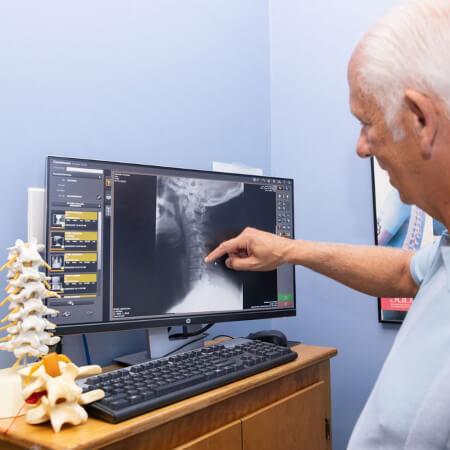
We Can Help at Discover Chiropractic Center
Your spine protects your spinal cord, the communication highway between your brain and every part of your body. When a vertebra becomes misaligned, it can place pressure on nearby nerves. That interference doesn’t just cause discomfort; it may affect how your body functions overall.
Research continues to show how closely the nervous system is tied to whole-body function. When communication is disrupted, your body may not respond as efficiently, whether that’s movement, recovery, or how you handle everyday stress.
Disc Problems: Bulges, Herniations, and Degeneration
Between each vertebra sits a disc, flexible, shock-absorbing, and essential for movement. These discs allow your spine to bend, twist, and handle the demands of daily life.
When the spine is misaligned, discs can bulge, herniate, slip, or weaken over time. This often leads to nerve pressure, stiffness, pain, and reduced mobility. In more advanced cases, long-term dysfunction may limit flexibility and affect the spine’s overall movement.
The focus in our clinic is on relieving that pressure and restoring proper motion so your body can recover naturally. If you’re dealing with a disc issue, a no-obligation consultation helps you understand what’s going on and what your options are moving forward.

Automobile Accidents and Whiplash
Whiplash is the most common injury following a car accident. The sudden force causes the neck to snap back and forth, overstretching muscles and straining soft tissues.
Beyond muscle soreness, this rapid motion may create spinal misalignments and even contribute to disc injuries or nerve irritation. These underlying issues are often what lead to lingering pain after the accident.
Dr. Ellis uses specific, controlled adjustments designed for injury recovery. By addressing both the soft tissue strain and the structural imbalance, care focuses on helping you heal fully, not just temporarily feel better.
Osteoarthritis and Joint Dysfunction
Osteoarthritis develops as the cartilage in your joints wears down over time. Previous injuries, repetitive use, or uneven movement patterns may all contribute.
When one joint becomes painful, your body naturally compensates by shifting stress to other areas, such as the hips, knees, or lower back. That’s why joint issues rarely stay isolated.
Chiropractic care works to restore proper motion, reduce pressure, and support more balanced movement across the entire body. Joint dysfunction, when movement becomes restricted due to injury, posture, or muscle imbalance, is also carefully evaluated so the true source of the problem can be addressed.
Neck and Back Pain
Neck and back pain are often the result of accumulated stress on the spine, poor posture, repetitive movement, and everyday wear and tear.
These stresses can create what chiropractors call subluxations, misalignments that place pressure on nerves and surrounding structures. Over time, this can lead to muscle tension, reduced mobility, and worsening discomfort.
Care at Discover Chiropractic Center focuses on correcting those imbalances, relieving nerve pressure, and helping your body move more freely again.
11 Questions a Chiropractor Should Ask About Your Neck Pain and Symptoms
Questions 1 and 2: “Where do you feel your neck pain is coming from? Is it only in your neck, or does the pain shoot into your shoulder, elbow, or hand sometimes?” This matters because a chiropractor wants to find out specifically where the pain is coming from. Since what a chiropractor does primarily is manipulation of the neck, they want to find out if the symptoms are coming from a vertebra being out of place in the neck, or if the symptoms in the arm are causing a problem in the arm. A chiropractor wants to find the exact cause of the problem.
Questions 3 thru 5: “Tell me, when did your neck pain begin? Was it all the sudden, or has it been gradually worsening over time? Why do you think time matters?” Letting a problem get worse over time obviously matters, something like letting a car’s faulty dashboard light stay red until the engine blows up. The issue commonly seen occurs with neglect due to the priorities in someone’s life, allowing something relatively simple to correct, to gradually worsen over time to where chronic issues like natural spinal fusion and atrophy can occur. The squeaky wheel gets the grease. Don’t put off today, well, you know the rest.
Questions 6 thru 9: “What might you be doing to cause the pain in your neck to get worse? Are you doing too much, or not enough? Is it worse when you move your head, lift something, sit or text too long? Why do you think what you do or aren’t doing matters?” Often symptoms are related to work. Texting can cause poor posture resulting in the neck having to be supported by the upper and thoracic trunk muscles because they are needed to hold the neck in flexion for too long. Problems also come from bad habits occurring because employers are asking their staff to do something that is only going to cause bad body dynamics to occur.
Spinal adjustments, coupled by using proper therapy modalities, along with teaching a patient specific exercises and proper stretches should help the affected area relax more, get stronger where it is needed, and allow the body to function the way it is supposed to.
Questions 10 and 11: “Often neglected is the body’s lack of proper sleep regarding how healthy a person is, and how their lack of sleep may be causing their symptoms to worsen. How are you sleeping? Why do you think sleep might be important to your overall health?” On a positive note, I can’t tell you how many times I have had a patient tell me that they slept better for the first time in months and even years after they had a spinal adjustment. Sleep, or lack of, is directly proportional to the body’s ability to allow the body to heal properly. Removing stiff, fixated joints allows the patient to rest comfortably, and with proper rest, healing can take place.
Headaches
Many people think headaches are just part of life, but in many cases, they’re a sign of underlying tension or imbalance.
One of the most common causes is tightness in the neck and shoulders. When muscles become tense, they place stress on the spine and surrounding nerves, leading to pain that may radiate into the forehead, temples, and behind the eyes.
By addressing both muscular tension and spinal alignment, chiropractic care can help relieve headaches and reduce their recurrence.
6 Questions Chiropractor Donald Ellis Might Ask You as a Patient with Headaches
Questions 1 and 2: When You Have a Headache, Where Exactly Does It Hurt?
Pain Characteristics:
Is it on one side or both sides? Is it mostly around the eyes (think allergies), forehead, or the side or back of the head? Headaches where chiropractors are possibly the best choice to find where the cause of cervicogenic headaches stems from. The where for this type of headache is that they typically start from the neck, run up the back of the head and spread to the front.
Tension headaches are known to start at the back of the head, the top, the front, and even the entire head. It is of major interest to most potential patients, and much relief, is that most of the tension headaches, and the areas they are involved with are usually the type of headache that primarily causes tension headaches.
Question 3: How Old Were You When You Remember Having Your First Troublesome Headache?
Someone who has never or almost never had a headache can show important “red flags” that can help the doctor better determine if the headache is simple as in a tension headache, or maybe a potentially dangerous condition that needs to be evaluated with more detail.
As we age, a new onset of headaches can increase the risk they are coming from a secondary area, meaning the headaches are a symptom of another medical issue.
Question 4: Where Do You Usually Feel the Worst of Your Headache Pain?
Understanding some of the most common issues that cause headaches like dehydration, hunger, and stress can help to determine the source of your headaches. By pinpointing headache location, it can help the doctor determine if the headache is primary (tension and migraine) headaches, or secondary headaches which are often of another, more serious, problem.
Question 5: What Are the Two Different Types of Headaches?
A Primary headache can include tension headaches, cluster headaches, and migraines. On the other hand, headaches that have a relation to infection, blood vessel problems, or injury are common secondary headaches. Mental health headaches are also part of the field of secondary headaches. Pain or inflammation that triggers on a headache is an example of a secondary headache coming from another condition.
Question 6: Does Routine Physical Activity, Such as Walking Upstairs, Make Your Headache Worse? Symptoms that worsen from a migraine or an “exertion headache” can temporarily increase blood flow and pressure inside your head, which can intensify a pulsating or throbbing headache.
If this happens, seek immediate medical attention if a headache during or after exercise is accompanied by any of the following:
- A sudden, explosive, or “thunderclap” pain.
- Loss of consciousness.
- Vomiting.
- Changes in vision.
- A stiff neck.
- Numbness or weakness.
Sciatica
Sciatica occurs when the sciatic nerve becomes irritated or compressed. This nerve runs from the lower spine through the hips and down the legs, which is why symptoms often include sharp, burning, or shooting pain along that path.
Although many people feel the pain in their hip, the source is usually in the lower spine or sacroiliac joint. Disc issues, muscle tension, or misalignment may all contribute.
Dr. Ellis focuses on resolving the issue at its source, reducing pressure on the nerve, and restoring proper movement.
What Causes Sciatica? Chiropractic Treatment Options Explained
Sciatic Nerve Anatomy: Location, Structure, and Function
The sciatic nerve is formed by the union of five nerve roots: L4, L5, S1, S2, and S3, which emerge from the lower lumbar and upper sacral areas of the spine. These roots merge deep in the gluteal region and pass close to the front of the piriformis muscle.
What Is Sciatica Nerve Pain? Causes & How to Treat It
Sciatica describes pain that radiates down the leg, often resembling a severe cramp. In some cases, the pain can be so intense that it hampers daily activities like sitting or standing. It may be triggered by sudden actions such as sneezing or coughing and is commonly accompanied by a persistent burning sensation in the leg. While sciatica usually affects just one leg, it can occasionally involve both. Pinpointing which nerve root is involved helps in identifying the source, as the sciatic nerve supplies both movement and sensation.
Spinal Sciatica: 9 Main Causes of Sciatic Nerve Pain
Vertebral Subluxation
Because the sciatic nerve roots exit the spinal column at the lumbar (L4, L5) and sacral (S1, S2, S3) levels, problems here frequently cause sciatica. Chiropractic care often includes spinal adjustments, heat or ice therapy, and other physical modalities. In severe cases, medication may be used for pain relief.
Herniated Lumbar Disc
Between each vertebra lies an intervertebral disc, which acts as a shock absorber. If the soft center of a disc pushes through its tough exterior, it can press on the sciatic nerve roots and cause symptoms. Most often, this involves a swollen or bulging disc rather than a complete herniation.
Spinal Stenosis
With age, the spine undergoes wear and tear that can cause the ligaments to thicken and bone spurs to form, narrowing the spinal canal. This can compress nerve roots, a problem sometimes made worse by vertebral subluxation.
Spondylolisthesis
Most common in the lower lumbar spine, spondylolisthesis occurs when one vertebra slips forward over another, often due to a bilateral fracture of the pars interarticularis. While it may not cause symptoms in some, more severe cases can compress nerves, leading to pain or weakness, especially involving the fourth or fifth lumbar vertebra.
Piriformis Syndrome
Piriformis syndrome involves irritation or compression of the sciatic nerve by the piriformis muscle, located in the buttocks. Anatomical variations in the muscle can also split and press on the nerve.
Degenerative Disc Disease
Degenerative Disc Disease (DDD), also known as Degenerative Joint Disease (DJD), involves the loss of water content and shrinking of spinal discs with age. This can make the discs fibrotic and brittle, sometimes leading to pressure on the sciatic nerve. Chiropractic adjustments may help by improving mobility in the affected vertebrae.
Tumors
Although rare, tumors in the pelvis or spine can compress the sciatic nerve along its path.
Bone Spurs
Bone spurs are bony outgrowths from the vertebrae, often linked to aging, which can pinch or press on the sciatic nerve. Chiropractic adjustments may help by realigning vertebrae, potentially reducing pressure and inflammation.
Traumatic Injury
Accidents, such as falls or car crashes, can directly injure or inflame the sciatic nerve. It is important to avoid electrical hot packs in these cases and instead use moist heat, like warm showers or Epsom salt baths, to relax the body. Applying ice packs in the early stages of treatment helps decrease swelling.
Carpal Tunnel Syndrome
Carpal Tunnel Relief in Mobile, AL | Chiropractic Care
Carpal Tunnel Syndrome (CTS) owns telltale signs other conditions may have, those being, numbness, tingling, and pain in the hand and fingers which come from the median nerve. Because there are so many other factors causing these same symptoms, it makes finding the correct diagnosis to be very difficult. If these symptoms are related to the median nerve, then CTS may be the problem. And, if the median nerve is the cause of the symptoms, it is likely due to it being impinged as it passes through the carpal tunnel at the wrist. Any impingement radiates these, or a collection of these symptoms to the thumb, index, middle, and ring fingers.
Considering the path of the nerve, it is important to understand the anatomy at and near where symptoms are likely to occur. The carpal tunnel is formed, at its base, by the two rows of wrist bones, called the carpal bones. These eight bones are lined up with four on the top and four on the bottom to form the floor of the canal. The median nerve sits on top of the carpals. The roof of the canal is composed of the transverse ligament, also known as the flexor retinaculum. Along with the median nerve, no less than nine tendons pass through the carpal tunnel.
Symptoms arise from enlargement and inflammation of the median nerve, of the nine tendons, and possibly from a thickening of the flexor retinaculum. A tumor or cyst within the tunnel can also cause radicular symptoms. If some, or any of these tissues are affected and the cause of these symptoms, then too much pressure on the median nerve will cause dysfunction causing problems.
“What They Don’t Tell You About Carpal Tunnel Surgery Safety and Costs”
First the numbers. According to a report from the National Institute of Health (NIH), a misdiagnosis of your case associated with CTS can have a failure rate of, not 60%, not 70%, but over 83% of the time. Think of it another way. This means over eight of ten surgeries were unneeded, not talking about the ramifications.
If you still don’t believe it, two credible organizations, the American Academy of Orthopedic Surgeons, and the NIH, have told their doctors to: “Advise your patients to use all non-surgical options first to treat their hand problems before considering surgery.” We hope that that is the case, but often the bottom-line – meaning the costs of pay out from health insurance companies – is likely what takes precedence.
Consider, in our state of Alabama, the average cost of carpal tunnel surgery according to CarpalRx is $6,901.
Further consider it takes 10 to 20 minutes, according to HSS (Hospital for Special Surgery) to perform one carpal tunnel syndrome surgery. Consider many surgeons can do a dozen or more surgeries in a day, that brings the math to upwards of $84,000 for a day’s work. Not bad.
Not Carpal Tunnel? 6 Other Causes of Wrist Pain
- Cervical Radiculopathy: If it’s not Carpal Tunnel Syndrome, then it very well could be a chiropractic case, and you might want to ask yourself who is the chiropractor near me in Mobile AL who has had great success in treating Cervical Radiculopathy. Compression or irritation of the C6 or C7 nerve roots in the neck can cause pain, numbness, or weakness in the arm, wrist, and hand, which can mimic CTS.
- Pronator Syndrome: Pronation occurs when the palm is facing down, so a Pronator Syndrome can cause nerve compression of the Median nerve at the elbow. This causes pain and numbness in the hand, particularly with pronation and forearm rotation.
- Thoracic Outlet Syndrome: This is named due to where the location of the compression of nerves and blood vessels in the spaces between the clavicle (collarbone) and the first rib. It too can cause pain, numbness, and tingling in the arm and hand.
- Multiple Sclerosis: This neurological condition signifies damage to the central nervous system. It has a variety of symptoms, some which include, numbness and tingling in the extremities, pain, muscle weakness, tremors and difficulty in fine motor skills
- Diabetic Neuropathy: Nerve damage due to diabetes can cause numbness, tingling, and pain in the hands and feet.
- Tenosynovitis: Inflammatory response to the tendon sheaths in the wrist can cause pain and swelling, and difficulty moving the wrist, mimicking CTS symptoms. It must be differentiated by location, history, and physical exam.
As you can see there is an extensive list, and with a longer list, the more potential of a misdiagnosis.
Let’s Talk About the Median Nerve and Why It’s So Popular
The median nerve gets more publicity than any other nerve in the arm. You don’t think so, you say? Read this: In a 2018 National Institutes of Health (NIH) study, the economic and financial load of carpal tunnel syndrome (CTS) treatment of the Medicare patient population was estimated to be between $2.7 and $4.8 billion annually. Since this study is specific to Medicare patients only, one could conclude the added costs paid out from health insurance companies and patient pay would exponentially be higher.
Median Nerve Pain: What Your Doctor Might Not Tell You
In the multi-billion-dollar industry of Carpal Tunnel Syndrome treatment many, if not most, are led to believe that the median nerve supply begins at the wrist – where the surgery takes place – instead of where it actually branches from, the spinal nerves in the neck. When carefully looked at, the median nerve supply exits from the spinal cord where five spinal nerves, the musculocutaneous, axillary, radial, ulna, and well as the median nerves branch at the brachial plexus in the shoulder.
Failed Carpal Tunnel Surgery: Symptoms, Causes, and Next Steps
While the internet tends to imply that post-surgery numbness, tingling, pain, and weakness in the hands and fingers AFTER surgery is SIMILAR to the patient’s symptoms before surgery, persistent or recurring symptoms realistically could be worse considering the possibilities noted below.
Starting with infection, which is always a risk after any surgery, there can be a disturbance to the healing process, causing damage to the median nerve and tendons to the fingers and thumb.
In regards to this article, the effect of the median nerve during a failed carpal tunnel release, can lead to further and potentially worse pain, a difference in sensation (sensory), in weakened grip (motor), and even permanent nerve damage.
On occasion the flexor retinaculum could still be the problem due to an incomplete release during surgery in the carpal tunnel leading to continued pressure on the medial nerve.
Fibromyalgia
Fibromyalgia is a chronic condition that causes widespread pain and heightened sensitivity throughout the body. Many people also experience fatigue, headaches, and mood changes.
While the exact cause isn’t fully understood, ongoing stress on the nervous system plays a role. Chiropractic care focuses on reducing that stress and improving overall function, helping support better day-to-day comfort.
Pinched Nerves
A pinched nerve can affect more than just one area. Because nerves extend from the spinal cord throughout the body, compression in one location may create symptoms elsewhere.
That’s why a thorough evaluation is essential. Dr. Ellis looks beyond surface symptoms to identify the source of the pressure, then uses precise adjustments to relieve it and restore proper communication within the body.
Chiropractic Care for Prevention and Wellness
Chiropractic care isn’t only about addressing discomfort; it’s also about maintaining how your body functions over time.
Regular visits help support alignment, mobility, and nervous system function. When everything is working together as it should, your body is better equipped to handle daily stress and stay active over the long term.
Chiropractic & Wellness Care Mobile, AL: Achieving Your Goals
As patients progress through their treatment protocols at Discover Chiropractic Center, reaching the level of long-term wellness care is often the most challenging—yet rewarding—milestone to achieve. True wellness should be a lifestyle lived and experienced every day. Unfortunately, it often takes a backseat to other, seemingly urgent obligations, even though nothing is more vital than your health.
Wellness care is a proactive approach to health. Instead of merely treating illnesses, masking symptoms, or managing chronic diseases caused by lifestyle choices, it emphasizes maintaining optimal physical, mental, and emotional well-being. While mainstream messages in the United States often promote pharmaceutical medications as a standard health routine, true wellness focuses on long-term prevention. In our Mobile, Alabama chiropractic office, wellness is strictly about empowering you to make intentional, healthy choices and developing the self-control needed to sustain a fulfilling life.
If you are suffering from discomfort or looking to optimize your health, you should be asking: “Who is the best chiropractor near me who prioritizes proactive wellness care?” At Discover Chiropractic Center, our specialized chiropractic care aligns seamlessly with these principles, acting as a cornerstone to optimize and maintain your health from the inside out.
Take the First Step
If you’re dealing with any of these concerns, or simply want to stay ahead of them, our Mobile team is here to help.
Call today to schedule your visit and take the next step toward feeling better.